The VIRGO interferometer needs six main mirrors. The 3 km long
Fabry-Perot cavities need four large mirrors (Input and End mirrors,
350 mm diameter, about 100mm thickness and 20 kg mass). Because
of their dimensions, we have developed new tools to manipulate
them between every step of the process in clean conditions with
a total safety. Such large components have never been coated in
the past, so it was a great challenge for us to succeed.
The beam splitter is 55 mm thick, it has a diameter of 230 mm
and a mass of 5 kg. The recycling mirror is 30mm thick and it
has a diameter of 350 mm.
The first set of the VIRGO main mirrors was ready in June 2002 as foreseen by the planning.
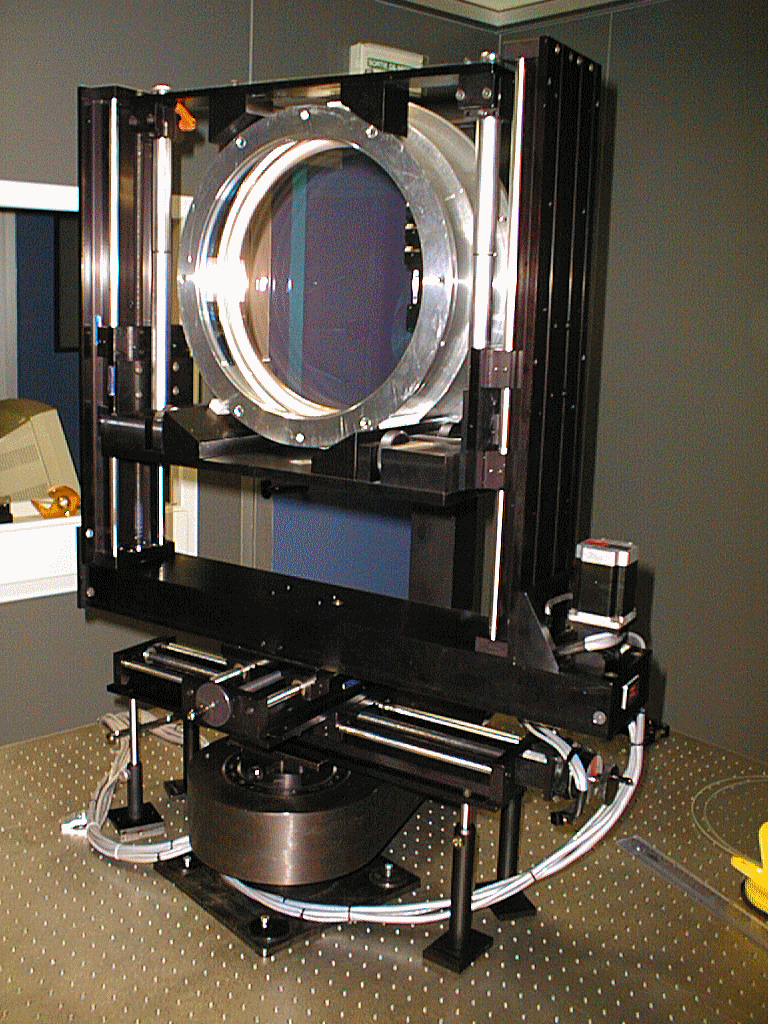
The picture below shows a real VIRGO end mirror in its characterization
mounting during the measurement of the scattering.

VIRGO End Mirror during the scattering
measurement
Now, the mirror installation on the VIRGO site in Italy is finished.
A summary of the optical performances of these large mirrors is
shown on the table
1.
The absorption and scattering requirements (< 5 ppm) are
satisfied for each component, especially for the absorption (in
the 1 ppm range). The dispersion in the absorption values only
comes from the coating design: the higher the reflectivity the
lower the absorption.
Some scattering values are higher than 5 ppm, but if we consider
only the surface corresponding to the laser beam size, the scattering
is in the VIRGO specifications.
Another remarkable result concerns the flatness of these large
components. The "8 nm RMS on 150 mm diameter " requirement on the
wavefront is always satisfied. Nevertheless, we found that the
limiting factor of the wavefront flatness is the substrate by
checking that the RMS flatness value is the same with or without
coating (Before: 3.38 nm RMS and 25.5 nm PV - After: 3.37 nm RMS
and 25.2 nm PV). The coatings reproduce exactly and even smooth
the substrate surface .
As the polishers can not guarantee every time better wavefronts,
the only solution is to correct the substrate surface before deposition
by the "Corrective Coating" technique.
An other Virgo requirement we had to satisfy is the finesse
inequality between the two Fabry-Perot cavities: (Df<1%).
To fulfill this requirement, the cavity mirrors must have transmission
values as close as possible. For instance, the difference between
the two Input Mirrors transmission must be lower than 0.2 %.